Dividing decimal numbers can feel confusing when the numbers contain several digits after the decimal point. Whether you are solving a school problem, checking a measurement, calculating money, or working with percentages, getting the correct decimal result matters. A calculator decimal division tool makes this process much faster and reduces the chance of making a calculation mistake.
Decimal division is simply the process of dividing one number that contains a decimal point by another number. For example, 12.5 ÷ 2.5 gives 5. While simple examples can be solved mentally, longer numbers such as 87.456 ÷ 3.24 can take more time when calculated manually.
A decimal division calculator handles these calculations instantly. You only need to enter the numbers, select division, and check the result. Understanding how the calculation works, however, is still useful because it helps you identify incorrect results and understand what the calculator is doing.
What Is Decimal Division?
Decimal division is the mathematical operation of dividing numbers that may contain decimal values. A decimal represents a part of a whole, so dividing decimals allows you to work with quantities that are not necessarily whole numbers.
For example:
7.5 ÷ 2.5 = 3
Here, 7.5 is the dividend, 2.5 is the divisor, and 3 is the quotient. The dividend is the number being divided, while the divisor is the number you are dividing by.
Decimal division is used in many everyday situations. You might divide a £25.50 bill between three people, calculate the price per item, determine an average measurement, or work out how much fuel is used per kilometre.
How Does a Decimal Division Calculator Work?
A calculator decimal division tool follows the same mathematical principle as ordinary division. The main difference is that the calculator performs the arithmetic automatically.
Suppose you need to calculate:
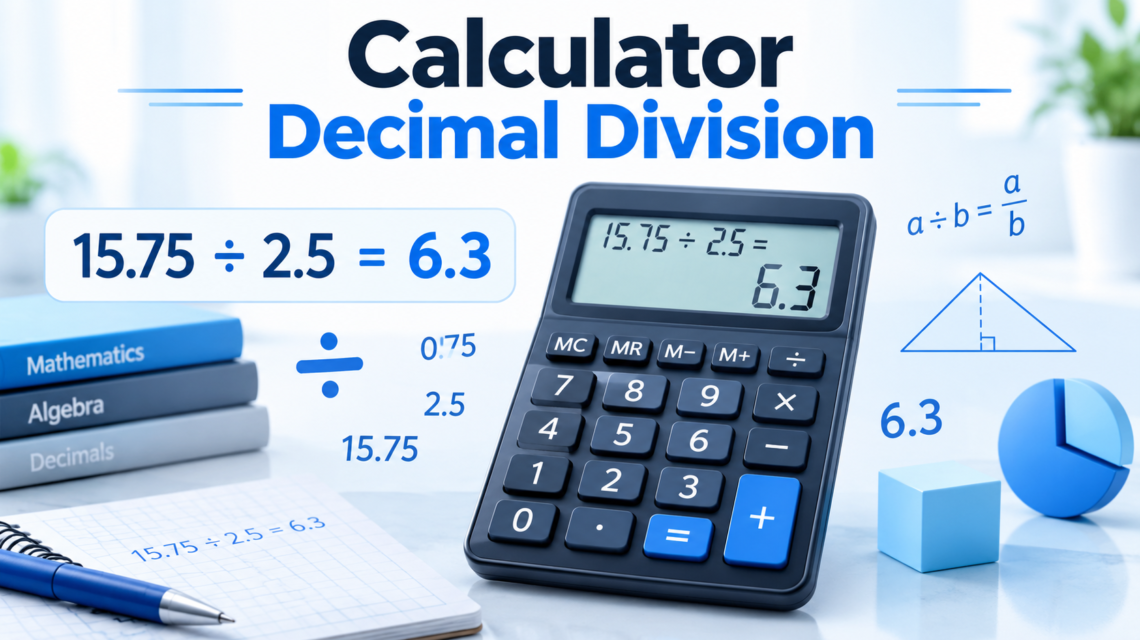
15.75 ÷ 2.5
Enter 15.75 as the first number and 2.5 as the second number. The calculator produces:
15.75 ÷ 2.5 = 6.3
The calculator processes the decimal values and returns the quotient without requiring you to move decimal points manually.
For more complicated calculations, a digital calculator is particularly useful because it can handle several decimal places accurately and quickly.
How to Divide Decimals Manually
Although a calculator is convenient, knowing the manual method can help you understand decimal division.
Consider:
12.6 ÷ 0.3
The divisor has one decimal place. To make it a whole number, move the decimal point one position to the right:
0.3 → 3
You must do the same to the dividend:
12.6 → 126
The calculation then becomes:
126 ÷ 3 = 42
Therefore:
12.6 ÷ 0.3 = 42
The important rule is that moving the decimal point in the divisor requires the same adjustment to the dividend. This keeps the value of the division unchanged.
Dividing a Decimal by a Whole Number
Dividing a decimal by a whole number is usually straightforward.
For example:
18.6 ÷ 3 = 6.2
You can perform the division from left to right while keeping track of the decimal point. A calculator makes this even easier.
Another example is:
45.75 ÷ 5 = 9.15
These calculations are common when finding averages, splitting costs, or determining the value of one item from a total amount.
If you frequently work with decimal values, entering the numbers directly into a decimal division calculator can save time and reduce arithmetic errors.
Dividing a Whole Number by a Decimal
Dividing a whole number by a decimal can look more complicated, but the same principle applies.
Take:
20 ÷ 0.5
Move the decimal point in 0.5 one place to the right:
0.5 → 5
Move the decimal point in 20 the same number of places:
20 → 200
Now calculate:
200 ÷ 5 = 40
So:
20 ÷ 0.5 = 40
This makes sense because there are forty groups of 0.5 in 20.
Dividing One Decimal by Another Decimal
When both numbers contain decimal points, using a calculator is often the quickest option.
For example:
8.64 ÷ 1.2
Move the decimal point in both numbers one place to the right:
8.64 → 86.4
1.2 → 12
The calculation becomes:
86.4 ÷ 12 = 7.2
Therefore:
8.64 ÷ 1.2 = 7.2
A decimal division calculator skips these manual steps and provides the answer immediately.
Decimal Division Examples
The following examples show how decimal division works in different situations.
| Calculation | Result | Type |
|---|---|---|
| 10.5 ÷ 2 | 5.25 | Decimal ÷ whole number |
| 15.6 ÷ 3 | 5.2 | Decimal ÷ whole number |
| 12.5 ÷ 2.5 | 5 | Decimal ÷ decimal |
| 8.64 ÷ 1.2 | 7.2 | Decimal ÷ decimal |
| 20 ÷ 0.5 | 40 | Whole number ÷ decimal |
| 7.5 ÷ 0.25 | 30 | Decimal ÷ decimal |
| 25.75 ÷ 5 | 5.15 | Decimal ÷ whole number |
These examples demonstrate why decimal division can produce whole numbers, terminating decimals, or longer decimal results depending on the numbers being divided.
Why Use a Calculator for Decimal Division?
Manual calculations are useful for learning, but calculators are practical when speed and accuracy are important.
A calculator decimal division tool can be especially useful for:
- Checking homework calculations
- Calculating prices and costs
- Dividing measurements
- Working with scientific values
- Finding average values
- Calculating unit prices
- Checking business calculations
- Solving mathematical exercises
- Working with percentages and financial figures
Another advantage is convenience. You do not need to write down multiple steps or worry about accidentally moving a decimal point too far.
Decimal Division in Everyday Life
Decimal division is not limited to classrooms. People use it regularly without necessarily thinking of it as mathematics.
Imagine you purchase 5.5 kilograms of rice for £11. The cost per kilogram is:
£11 ÷ 5.5 = £2 per kilogram
Similarly, if a car travels 360.5 kilometres using 25.5 litres of fuel, dividing the distance by the fuel used gives an approximate distance per litre.
Decimal division also appears when splitting bills. If a restaurant bill is £84.60 and four people share it equally:
£84.60 ÷ 4 = £21.15
Each person would pay £21.15.
These simple examples show why having a reliable way to calculate decimals can be useful beyond academic work.
Common Mistakes When Dividing Decimals
Decimal calculations can produce errors if the decimal points are handled incorrectly.
One common mistake is moving the decimal point in the divisor but forgetting to make the same adjustment to the dividend. Both numbers must be changed by the same factor.
Another mistake is entering the numbers in the wrong order. Division is not commutative, meaning:
10 ÷ 2 = 5
but:
2 ÷ 10 = 0.2
The result changes when the order changes.
It is also important to check whether the divisor is zero. Division by zero is undefined, so a calculator cannot provide a normal numerical answer for an expression such as 10 ÷ 0.
Terminating and Repeating Decimal Results
Not every decimal division produces a short answer.
For example:
1 ÷ 4 = 0.25
This is called a terminating decimal because the digits eventually stop.
However:
1 ÷ 3 = 0.333333…
produces a repeating decimal. The number 3 continues indefinitely.
A calculator may display only a limited number of decimal places depending on its settings. For example, it might show 0.333333 rather than displaying the repeating pattern indefinitely.
When precision is important, you should pay attention to how many decimal places the calculator displays.
How to Get Accurate Decimal Division Results
Accuracy is important when decimal calculations are used for money, measurements, business, or scientific work.
Before calculating, check that the numbers have been entered correctly. A single missing decimal point can completely change the result.
After getting an answer, you can also multiply the quotient by the divisor to check your work.
For example:
18.75 ÷ 2.5 = 7.5
Check:
7.5 × 2.5 = 18.75
Because the original dividend is recovered, the calculation is correct.
This simple reverse-checking method works well for many division problems.
When Should You Round a Decimal Answer?
Sometimes a division result contains many decimal places. In those cases, rounding may be necessary.
For example:
10 ÷ 3 = 3.333333…
If you need two decimal places, the answer becomes:
3.33
If you need three decimal places, it becomes:
3.333
The correct number of decimal places depends on the purpose of the calculation. Financial calculations may require two decimal places, while scientific or engineering work may require much greater precision.
Avoid rounding too early when performing multiple calculations because it can introduce small errors into the final result. When possible, keep the full calculator result until the final step.
Calculator Decimal Division for Students
Students often encounter decimal division in arithmetic, algebra, percentages, measurements, and word problems.
Using a calculator can help students check whether their manually calculated answer is correct. However, it is useful to understand the underlying method rather than relying entirely on a calculator.
A good approach is to solve the problem manually first, then enter the same calculation into the calculator. If the results are different, review the decimal placement and arithmetic steps.
This approach turns the calculator into a checking tool rather than simply an answer generator.
Calculator Decimal Division for Work and Business
Businesses frequently deal with decimal numbers. Prices, quantities, wages, taxes, discounts, measurements, and financial ratios can all involve decimal division.
For example, a company purchasing 125.5 units of material for £2,510 may want to know the cost per unit:
£2,510 ÷ 125.5 = £20 per unit
A quick calculation can help businesses compare suppliers, estimate costs, and analyse prices.
For repeated calculations, using a calculator can also reduce the time spent on routine arithmetic.
Tips for Using a Decimal Division Calculator
Getting the best results from a calculator is simple when you follow a few basic habits.
First, enter the dividend and divisor carefully. Check the decimal points before pressing the calculate button.
Second, look at the result and consider whether it makes sense. If you divide 50 by 2.5, for example, an answer of 200 would immediately deserve another check.
Finally, keep the original calculation visible whenever possible. This makes it easier to find an input error if the result looks unusual.
A reliable decimal calculator should make the process simple, clear, and quick without unnecessary steps.
Final Thoughts
Decimal division is an important mathematical skill that appears in education, shopping, finance, business, science, and everyday calculations. While the manual method is useful for understanding the mathematics, a calculator decimal division tool offers a quick and convenient way to handle calculations.
Whether you are dividing money, measurements, prices, or ordinary decimal numbers, the key is to enter the values carefully and understand what the result represents. When greater accuracy is required, avoid unnecessary rounding and keep extra decimal places until the final step.
With a reliable calculator and a basic understanding of decimal division, even complicated-looking calculations can become quick and manageable.
Frequently Asked Questions
What is decimal division?
Decimal division is the process of dividing one decimal number by another number. The numbers can contain one or more digits after the decimal point.
How do I divide decimals with a calculator?
Enter the first number, select the division operation, enter the second number, and calculate. Make sure both decimal points are entered correctly.
Can I divide a whole number by a decimal?
Yes. A whole number can be divided by a decimal just like any other number, as long as the divisor is not zero.
Why does my calculator show many decimal places?
Some divisions produce repeating or very precise decimal results. The calculator may display several digits depending on its precision and screen settings.
How can I check a decimal division answer?
Multiply the result by the divisor. If the calculation returns the original dividend, your answer is correct, allowing for any rounding that was used.